
Procedure
Updated June 15, 2026
Authors: Rami Mossad Ibrahim, Magnus Obinah, Magnus Balslev Avnstorp MD, Peter Stemann and Birgitte Jul Kiil
Procedure (Photos)

Step 1: Pre-operative drawing
Pre-operative drawing of donor site with two large periumbilical arterial perforators (a DIEP flap) and recipient site (internal mammary artery of left breast)

Step 2: Harvesting of perforator flap

Step 3: Microsurgical anastomosis
Microsurgical anastomosis of vessels on recipient site using clips

Step 4: Closure of abdominal donor site/defect.

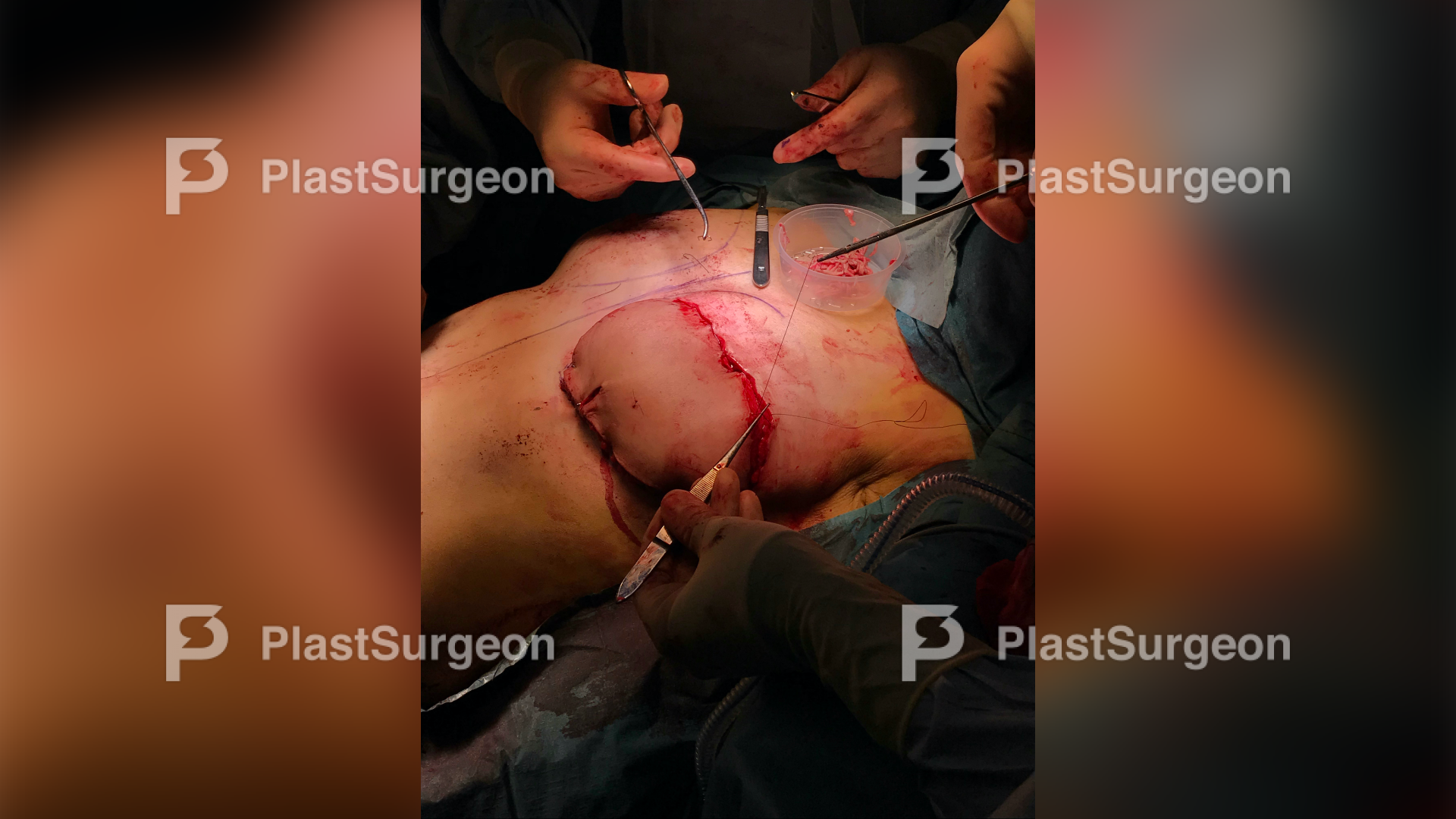
Step 5: Suturing of DIEP flap to the left breast
Suturing of DIEP flap to the left breast (recipient site) – The reconstructed breast
Instruction to the patient
Pre-operative regimen
Post-operative calm regime.
Follow-up
Clinical flap assessment by laser and/or hand ultrasound doppler every hour the first 24 hours and the following days.
See: **LINK TO CHAPTER ON MONITORING MICROSURGERY FLAPS**
Depending on the complexity of the flap the monitoring may be less extensive.
Pearls and Pitfalls when performing perforator flaps
- Overall use Diligence (careful and persistent work) and intelligence.
- Use appropriate imaging technology if possible.
- Make sure that you have a recipient vessel in mind when planning a free perforator flap.
- Have a Plan A, Plan B, Plan C if the vessel is no good.
- Be aware and respectful that harvesting a perforator flap is difficult.
- Remember that small perforator flap vessels can be anastomosed to other small perforator vessel as recipient vessels, which can be useful on legs etc.
- Practice using magnifying glasses (loup glasses).
- In case you have a small defect ie on a leg following cancer resection, then practice looking for a perforator flap nearby. Try to do a propeller flap instead of a random flap or a skin transplant.
- Minor perforator flaps are also very useful in the face.
- Look after perforator vessels near the defect with ultra sound before the resection.
- The perforator vessels are often very small and fragile. Be careful and have fun!
References
- Koshima I, Soeda S. Inferior epigastric artery skin flaps without abdominis muscle 1989:645–8.
- Blondeel PN, Van Landuyt KH, Monstrey SJ et al. “the ”gent“ consensus on perforator flap terminology: preliminary definitions”. plast. reconstr. surg. 112 (5): 1378–83; quiz 1383, 1516; discussion 1384–7. 2003.
- Color Doppler ultrasonography targeted reconstruction using pedicled perforator flaps—a systematic review and meta- analysis- Rami Mossad Ibrahim, Gudjon Gunnarson, Javed Akram, Jørn Bo Thomsen and Jens Ahm Sørensen.
Next step
Keep going with Premium
Practise with the MCQ bank, follow structured courses and read the full handbook.
See Premium